
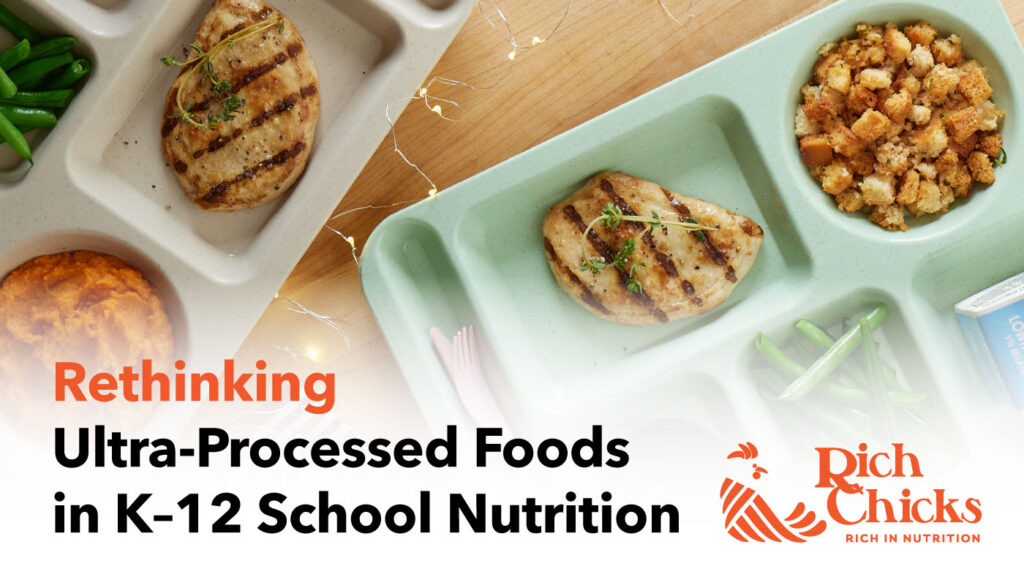
Rethinking Ultra-Processed Foods in K–12 School Nutrition
Subject: Comments on efforts to define “ultra-processed foods” (UPFs) for federal nutrition policy
On behalf of Rich Chicks, a USDA commodity processor serving over 1,000 school districts across 30 states, we appreciate the opportunity to provide input to the United States Department of Agriculture (USDA) regarding the development of a uniform definition for ultra-processed foods (UPFs).
Founded on the principle of delivering “Better for You” poultry, our K-12 product line is built around whole muscle chicken breast ( approx. 20 grams protein per serving) —providing approximately 33% of the RDA protein target—coated with whole grain breading and carefully formulated to be lower in fat, sodium, and allergens, without egg, soy, dairy, phosphates, added sugars, or trans fats. Our products consistently align with, and often exceed, USDA National School Lunch Program requirements for protein, whole grains, sodium, calories, and nutrient balance.
Executive Summary—Our recommendations
- Do not adopt a single process-only definition (e.g., NOVA) into regulation. Varying taxonomies group nutritionally dissimilar foods together, which risks confusing consumers and schools without improving diet quality.
- Center policy on nutrient density and ingredient transparency. Use clear, measurable thresholds (e.g., protein per serving, added sugars = 0 g, sodium within NSLP phase limits, whole-grain-rich where applicable).
- Create a K–12 “safe harbor.” Entrées that meet NSLP/SBP nutrient standards and exclude specified additives should not be penalized by a process label.
- Adopt a simple tiered continuum instead of a binary label. Distinguish nutrient-dense staples/entrées from energy-dense, low-nutrient snacks.
- Pilot before rulemaking and assess operational impact. Evaluate effects on menu variety, participation, waste, cost, and vendor availability, particularly in small and rural districts.
USDA Response: Definition of Ultra-Processed Foods
We respectfully caution that establishing any federal definition of “ultra-processed foods” (UPFs) risks legitimizing a concepts, such as NOVA, are overly broad, lack standardization, and classify foods with vastly different nutritional profiles into the same category. This creates confusion for parents, consumers, and professionals while offering little practical value for improving public health. At the same time, such a definition would impose unintended burdens on schools that rely on safe, nutrient-dense pre-prepared foods to meet meal standards within real-world constraints of staffing, equipment, time, and budgets. To be effective, recommended federal guidance must move beyond process-based labels and instead emphasize nutrient density, ingredient transparency, and feasibility in application.
Problems with the Current Concept
NOVA’s food classification system, the most frequently cited framework for UPFs, lacks clarity or standardization. Its categories are too encompassing and open to interpretation, placing foods of vastly different nutritional quality in the same classification. For example, apple slices preserved with a naturally derived antibacterial agent such as ascorbic acid would be treated the same as a highly processed snack food with little nutritional value. Such generalizations do not help consumers, parents, or nutrition professionals make better choices.
By focusing primarily on manufacturing techniques and the number of ingredients, current definitions obscure what matters most: nutrient density and ingredient quality and transparency. Simply running down a manufacturing line does not make a food unhealthy; conversely, some minimally processed foods can still be high in added sugars, sodium, or unhealthy fats.
“Simply running down a manufacturing line does not make a food unhealthy.”
Nutrient Density and Ingredient Transparency Must Be Central
Any federal guidance must prioritize nutrient density and ingredient transparency over rigid process-based categories.
We support guidance that prioritizes what the food delivers and what it contains, not how many steps it took to make. For K–12, practical, verifiable criteria could include:
- Protein: ≥ 14–20 g per entrée (age/grade appropriate).
- Added sugars: 0 g for savory entrées; limits aligned to DGAs for other categories. (Dietary Guidelines for Americans)
- Sodium: Within current NSLP (National School Lunch Program) /(School Breakfast program) SBP phase limits.
- Whole grains: Whole grain-rich where applicable.
- Ingredient transparency: Exclusion lists for designated additives; clear labeling.
Under such criteria, foods like whole-grain breaded chicken entrées with robust protein, modest sodium, and 0 g added sugars—and items such as hummus or pre-cut fruit using standard food-safety/quality agents—should be fully distinguishable from chips, candy, and sugar-sweetened desserts.
As school nutrition professionals have emphasized, protein-rich main entrées must be distinguished from low-nutrient processed snacks. Ingredient lists, nutrient contribution, and alignment with DGAs—not processing level alone—should guide classification.
Practical Realities in Schools
Since the Healthy, Hunger-Free Kids Act, schools have significantly improved meal quality, increasing whole foods, reducing sodium and added sugars, and enhancing scratch preparation where possible. Yet schools face staffing shortages, equipment limitations, compressed lunch schedules, and budget constraints. Pre-prepared nutrient-dense foods are essential to maintaining variety, safety, and student participation.
Restricting these foods under an overly broad UPF definition would have unintended consequences: reduced menu options, increased food waste, and risk of manufacturers leaving the K-12 market rather than adapting to inconsistent requirements. The result would be fewer nutritious meals available to children, many of whom rely on school lunch as their healthiest meal of the day.
Toward a More Useful Framework
Instead of adopting a broad UPF definition, USDA should consider developing a continuum or tiered classification system that distinguishes between:
- Foods with meaningful nutrient contributions (protein, fiber, vitamins, minerals).
- Foods with empty calories, excessive sodium, or added sugars.
- Ingredient profiles that align with consumer interest in transparency and clean labeling.
A helpful starting point is the Ingredient Guide for Better School Food Purchasing, which identifies specific additives and ingredients widely recognized as less healthful. This approach provides a more actionable framework for parents, schools, and consumers while avoiding the pitfalls of an oversimplified definition.
Conclusion
Rich Chicks supports HHS strategy to reverse the decline in children’s health and the combined strategy including nutrition, physical activity, reduction to exposure of environmental chemicals, and over medication to improve children’s health. However, we believe that supporting clinical research based scientific evidence, delineating healthy nutrient dense foods in conjunction with several helpful categories, ingredient transparency, and balancing the operational feasibility of the strategies will provide the desired results.
Any attempt to define UPFs as a singular category risks entrenching a flawed, confusing concept. Instead, USDA should lead in developing a science-based, nutrient-and ingredient-focused continuum that distinguishes beneficial forms of processing from those that diminish dietary quality. Such an approach would help schools continue serving safe, appealing, and nutritious meals while empowering parents and consumers to make informed choices.
By moving beyond the problematic “ultra-processed” label and toward a practical framework rooted in nutrient density and ingredient transparency, USDA can avoid unintended barriers and support meaningful improvements in children’s health and well-being.